|
 |
||||||||||||||
 |
|
||||||||||||||
|
|||||||||||||||
 |
 |
 |
 |
 |
 |
 |
 |
 |
|||||||
 |
 |
 |
 |
 |
 |
 |
|||||||||
 |
|||||||||||||||
|
|||||||||||||||
El Tren del Fin del Mundo •
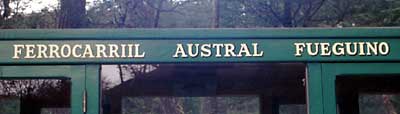
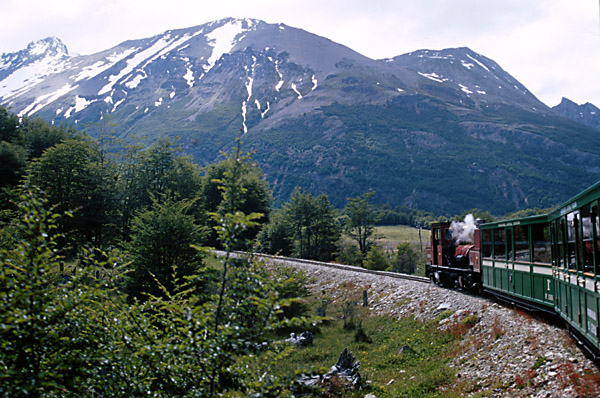
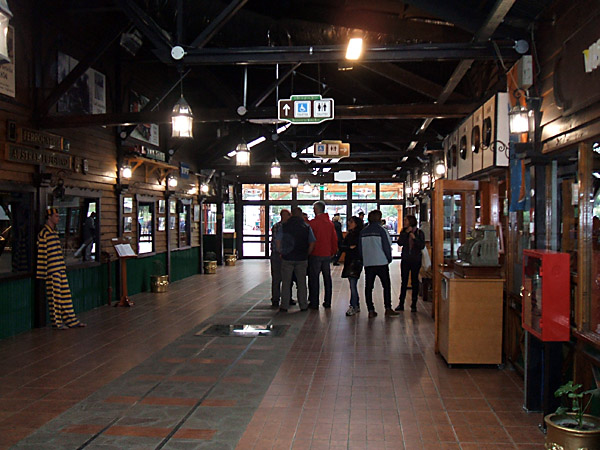
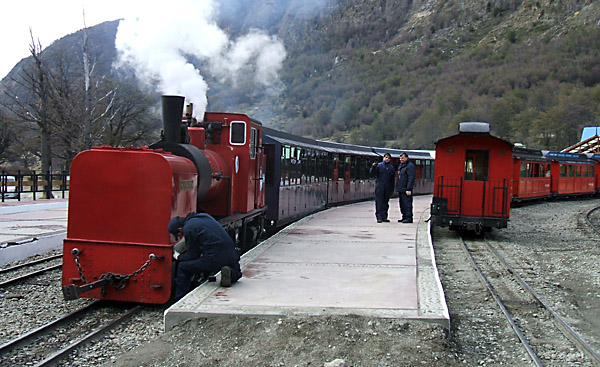
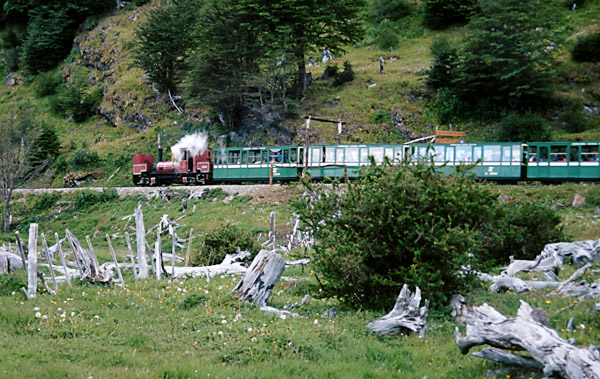
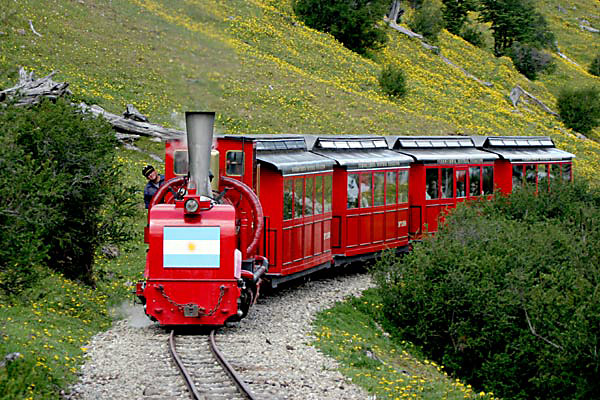
La Garratt Nº 2 Nora como era en aquel tiempo corriendo por el parque nacional el 1 de enero 2001. En los añs 1990, parte del trazado del ferrocarril del presidio ha sido reutilizado en una línea turística, de trocha 50cm, que se llama El Tren del Fin del Mundo, o, más oficialmente, el FC Austral Fueguino. Está explotado por Tranex Turismo SA de Buenos Aires. Hay dos máquinas a vapor nuevas, construidas específicamente para la línea. Una de esquema de ruedas 0-4-0+0-4-0, articulada tipo Garratt, Nora, que fue construida en Buenos Aires y una 2-6-2T, en estilo del FC Lynton & Barnstable (Inglaterra), Camila, construida por la empresa Winston Engineering en Inglaterra. También hay dos máquinas diesel de trocha cambiada, una Ruston y otra O & K. El ferrocarril desarrolló muy rápidamente desde un ferrocarril, casi miniatura, como los turísticos ingleses de trocha 38,1cm, hasta uno de servicio mucho más superior, que quisas sería mejor de una trocha una poquita más ancha. La historia del desarrollo de la línea durante los últimos quince años es una saga derespondiendo al incremento continuo en el tráfico y como se han cambiado su equipo y infraestructura para su rol nuevo. La línea tiene su propio sitio web, también disponible en inglés, portugués y francés. El incremento rápido en el turismo en Ushuaia, especialmente por razón de los cruceros antárticos usando el puerto como punto pivote de su viaje, ha impulsado el carácter cambiado del ferrocarril. La repuesta de la compañía ha sido hecho en la mayoría por la imaginación, talentos e intereses del Señor Shaun MacMahon, gerente técnico del ferrocarril entre 1999 y 2004 y hasta hoy en capacidad consultiva. Está disponible una biografia (en inglés solamente) del Señor McMahon en el sitio web de Martyn Bane tratando del desarrollo del vapor. Shaun McMahon mismo ha notado las etapas del crecimiento del ferrocarril como: Para clarificar el desafío enorme que ha enfrentado a la dirección y el personal del FCAF, solo es necesario notar que el ferrocarril miniatura original tenía la capacidad de llevar posiblemente unos 15.000 pasajeros por año. Quince años más tarde, la cifra de pasajeros acerca a casi diez veces más grande. La línea Una vista dentro la estación Fin del Mundo siguiendo su remodelación en 2010. El hombre a la izquierda está vestido en el uniforme de la cárcel que es familiar en las fotos de las páginas previas de este capítulo.
Hay una propuesta vieja para extender la línea hasta el centro de Ushuaia. Aunque tenía bastante razón financiera, está superada por la reciente expansión rápida de la ciudad La nueva máquina Garratt Ing H.R. Zubieta espera a la cabeza de su tren para la salida hacia el Parque Nacional. Detrás se ve el escenario típico alrededor de la estación principal en octubre de 2010.
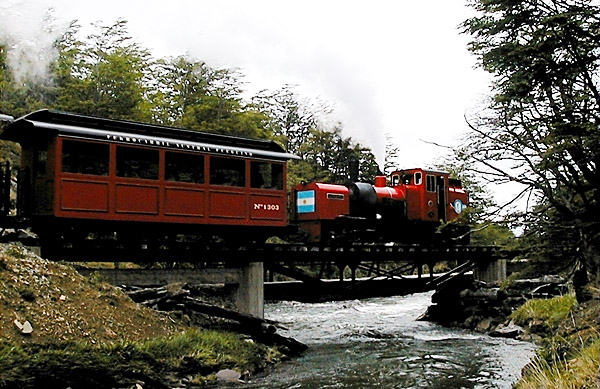
El sitio también tiene un galpón para coches y una exposición histórica. El acceso es por una plataforma móvil (como una plataforma giratoria, pero con su pivote a un término y con su movimiento limitado a un ángulo chico). Fuera de la estación los trenes marchan al lado del Río Pipo en parte en una traza nueva porque el río ha destruido bastante de la antigua traza del ferrocarril del penitenciario. De vez en cuando se ve a los durmientes antiguos por donde corrían las máquinas antiguas, y por todos partes hay viejos troncos talados— ¡reliquias del trabajo duro! Raramente ferrocarril tan corto tiene tantas cosas que contar. Máquina N° 5 cruce el Puente Quemado en noviembre de 2006.
Las máquinas trabajan duramente aquí en dirección al parque porque la fuerte pendiente llamada Macarena comienza al otro lado del puente. Su inclinación es cerca de 3,3%, la más severa del ferrocarril.
En la cima está la estación de mitad del trayecto donde los trenes paran quince minutos, más o menos. Las Cascadas de Macarena están cerca y hay una pequeña exposición mostrando como vivían los indígenas. En esta foto, sin fecha, la mayoría de los pasajeros han desembarcados para visitar las atracciones en La Macarena. Camila ha recibido su escape Lempor, la chimenea grande y otras modificaciones, pero el tren está compuesto de material rodante viejo.
A los que están acostumbrados a la estepa árida de la Patagonia argentina, el sur de Tierra del Fuego es muy verde. El tren se ha reunido con sus pasajeros, y continúa al lado del río hacia el límite del parque nacional.
La parte superior de la ruta pasa junto a ejemplos maravillosos de turbarías elevadas para llegar al término. Unos pasajeros entran a pie al parque, y vuelven por tren. Aficionados del riel quieran explorar una de las antiguas trazas forestales. La misma máquina, la N° 2 Ing. L.D. Porta, pero tres años más tarde, siguiendo su remodelación extensiva en cargo de un tren de coches más modernos al oeste de la estación La Macarena en 2004.
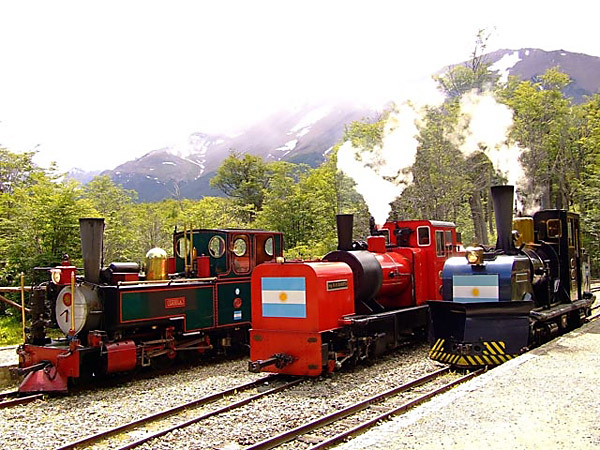
Se ven conjuntas las tres máquinas a vapor las N° 3, 5 y 2 en la terminal de afuera, Parque Nacional.
Infraestructura Operaciones La pendiente de La Macarena es la que da la limitación al poder motriz de las locomotoras. Por ejemplo Nora in original form puede marchar con seis coches en el asenso. 31-7-12 |
|||||||||||||||
 |
|
|
|
|
|
|
|
|
|
|
|
|
|
|
|
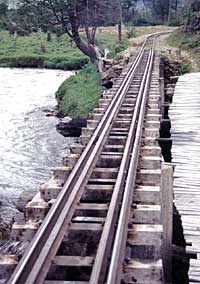 La línea cruza el río en Puente Quemado. Este es un puente nuevo pero sobre la traza antigua. Un puente peatonal está a la derecha, a nivel más baj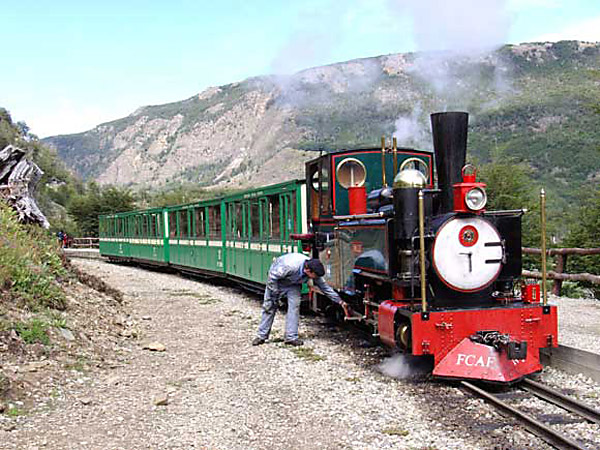
Capítulo 10
El fc penal y el 'Tren del Fin del Mundo'
Guía al sitio